28th Sunday in Ordinary Time – Year A (2026)
This Sunday, the readings present us with a beautiful and concrete image: a banquet prepared by God. It is a rich and abundant banquet, open to everyone. It is an image of salvation, communion, and the fullness of life that God desires to offer to every human being.
The prophet Isaiah tells us: “The Lord of hosts will prepare for all peoples, on this mountain, a banquet of rich food and excellent wines.”
God is not a God who takes away, impoverishes, or makes life sorrowful. He is a God who prepares, who invites, and who desires to share His joy with us. And there is something important here: the banquet is prepared for all peoples. No one is excluded from God’s invitation. His desire is to gather, not to divide; to heal, not to wound; to wipe away tears, not to increase them.
Isaiah adds a remarkable statement: “He will destroy the veil that veils all peoples.” How often, too, do we live with a veil before our eyes a veil made of fear, worries, disappointments, failures, and loneliness? At times, we can no longer see God’s presence in our lives. Yet God promises to remove that veil. He invites us to look at reality with new eyes and to discover that, even in the midst of difficulties, we are not alone.
St. Paul, in his Letter to the Philippians, gives us a concrete testimony of this trust. He says: “I have learned to be self-sufficient in every circumstance.” And then: “I know how to live in poverty, and I know how to live in abundance.” Paul does not say that everything always went well for him. He experienced hardship, persecution, and deprivation. Yet he learned something fundamental: his joy does not depend on circumstances, but on the presence of Christ. That is why he can say: “I can do all things through Him who gives me strength.” This statement does not mean that, with God, we can obtain anything we desire. It means something deeper: I can face every situation without losing hope, because Christ is my strength. And it is precisely here that we can connect the second reading with the Gospel.
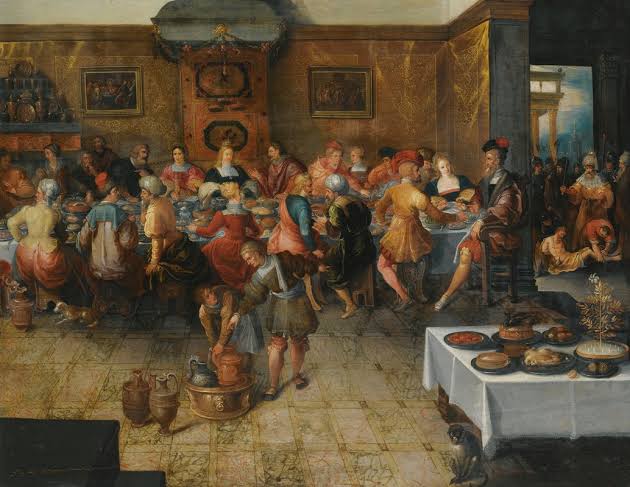
Jesus tells the story of a king who prepares a wedding banquet for his son. Everything is ready. The guests have been invited. But when the time for the celebration arrives, many refuse the invitation. It is an image that speaks very strongly to us today. We, too, are continually invited by God. Every day, God says to us: “Come. I have prepared a place for you. Your life is not made up only of duties, problems, and worries. There is a celebration to which you are called.”
And yet, we can refuse the invitation not necessarily by openly saying “no” to God. Sometimes we refuse it simply because we are too busy. We have so many things to do, so many thoughts, and so many plans. And so we risk having no time left to listen to God, to pray, to encounter others, or to notice those who are suffering.
The Gospel places before us a very simple question:
Do I still have room in my life for God’s invitation?
Because God continues to prepare the banquet. He continues to call us. He continues to tell us that our lives can become a celebration, a communion, and a sharing. But in order to take part, we must accept the invitation. And accepting the invitation does not simply mean entering a church or carrying out certain religious practices. It means allowing God to change our hearts. It means learning to live with gratitude, to share, to forgive, to serve, and to look upon others not as strangers, but as brothers and sisters.
God’s banquet already begins here, in our everyday lives. Every time a family finds peace again, the banquet has already begun. Every time someone forgives, the banquet has already begun.
Every time we share what we have with someone who has less, the banquet has already begun.
Every time a lonely person finds someone willing to listen, the banquet has already begun.
And perhaps this is the question with which we can return home today:
What place does God occupy in my life? Am I among those who have received the invitation but always have an excuse not to participate? Or am I learning, like Paul, to trust God in every situation?
Isaiah reminds us that the Lord desires to wipe away the tears from every human face. Paul teaches us that we can face every situation with the strength that comes from Christ. Jesus, finally, reminds us that we are invited to a celebration. We are not Christians because we have discovered a series of rules to follow. We are Christians because we have received an invitation.
An invitation to joy. An invitation to communion. An invitation to life.
And before this invitation, we can choose to continue along our own path, absorbed in our worries, or we can stop, listen, and say: “Lord, here I am. I want to come to Your feast. I want to learn to live with You.” The Lord has prepared the banquet. The table is ready.
The invitation is in our hands. It is up to us to welcome it.
HAVE A BLESSED SUNDAY, EVERYONE!!!