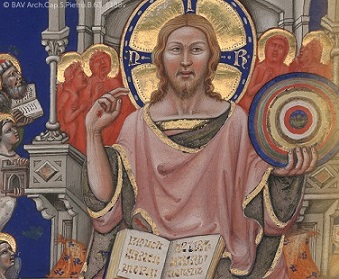
Solemnity of Our Lord Jesus Christ, King of the Universe
“Whatever you did for one of the least of these brothers and sisters of mine, you did for me.”
The Solemnity of Christ, King of the Universe, invites us to contemplate a King unlike any other. He is a King who does not rule by imposing His power, who does not seek subjects to dominate, and who does not build His kingdom on strength, wealth, or prestige. Jesus is a King who becomes a shepherd, who bends down to tend the wounds of humanity, who seeks out those who have lost their way, and who cares for those who have been left behind.
The readings for this Sunday help us understand the true face of this Kingdom and the path we are called to follow to become part of it.
In the first reading, through the prophet Ezekiel, God reveals Himself as a shepherd who personally cares for His flock: “I myself will search for my sheep and look after them.” What a beautiful image, revealing the very heart of God! He is not a distant ruler, seated on His throne and indifferent to the struggles of His people. He is a God who seeks, who accompanies, who binds up wounds, and who brings home those who have wandered away. He is a God who never gives up on anyone. This image also helps us understand the kingship of Jesus: His power is the power of love expressed through service, of mercy that never abandons, and of closeness that restores human dignity. Jesus does not reign from above; rather, He walks alongside humanity, especially when people are fragile, wounded, and lost.
In the second reading, Saint Paul reminds us that Christ is the conqueror of death: “Christ has been raised from the dead, the firstfruits of those who have fallen asleep.” The kingship of Jesus is not limited to the events of human history; rather, it opens before us the horizon of eternity. He is the Lord of life, the One who passed through death and conquered it, and the One who will bring the Father’s plan of salvation to completion. Yet this victory is not one achieved through weapons or oppression. It is the victory of love, given freely and completely, even to the very end. It is the victory of a King who, to save humanity, did not hesitate to ascend the Cross. And so we come to Matthew’s Gospel, which presents us with a magnificent scene: the Son of Man comes in His glory, and all nations are gathered before Him. This is the final judgment, the moment when the truth of our lives is brought to light.
But there is one detail that surprises us and should lead us to deep reflection: Jesus does not ask how many achievements we have accomplished, how much wealth we have accumulated, or how important we have been in the eyes of others. He does not even ask how many religious words we have spoken or how often we have attended gatherings within our communities.
The decisive question concerns love.
“I was hungry, and you gave me food; I was thirsty, and you gave me drink; I was a stranger and you welcomed me; naked and you clothed me; ill and you cared for me; in prison, and you visited me.” Jesus identifies Himself with the least among us: the poor, the hungry, the strangers, the sick, and those who are lonely and forgotten. He tells us something extraordinary: every time we draw near to someone who is suffering, we draw near to Him. Every time we reach out to someone in need, that hand reaches the very heart of Christ.
And yet, in the Gospel, both the righteous and those who failed to perform these acts of love ask the same question: “Lord, when did we see you?”
Here we discover one of the deepest teachings of this solemnity. The righteous had not even realised that they had encountered Jesus. They had not performed extraordinary deeds to earn their place in heaven. They had simply loved. They had learned to recognise the needs of others, to stop, to listen, to share, and to become close to those in need. Perhaps without fully realising it, they had understood that faith cannot be separated from everyday life, and that love for God becomes genuine when it is translated into concrete love for our brothers and sisters.
And so we come to the question this feast places before each one of us: Where does Christ reign in our lives?
We may recognise Him in our celebrations, in our prayers, and in our churches, but are we also able to recognise Him in the person who inconveniences us, in the one who asks for our time, in the one who needs someone to listen, and in the one who has nothing to give us in return?
Sometimes we look for Christ in great events, extraordinary experiences, and moments when we feel His presence most strongly. Yet He is waiting for us in the ordinary moments of everyday life, in the faces of those we meet each day, and in the small opportunities to do good that we so often risk overlooking. Perhaps we will not be asked to perform heroic deeds. Rather, we will be asked not to remain indifferent. To notice those who are lonely. Not to turn our backs on those who suffer. To find the courage to forgive, to welcome, and to share.
For the Kingdom of Christ grows precisely through these simple gestures, often hidden from the eyes of the world, yet capable of changing people’s lives.
To celebrate Christ the King, then, means making room for Him in our lives. It means allowing His way of loving to become our own. It means abandoning the logic of domination, selfishness, and indifference in order to embrace the values of service, brotherhood, and mercy.
The Gospel does not present us with a King whom we should simply admire from a distance, but with a King whom we are called to follow. And following Him means learning to recognise Him where we would least expect to find Him: in the faces of the least among us.
At the end of our lives, we will not take with us our titles, our wealth, our personal achievements, or the recognition we have received. What will remain is the love we have been able to give. What will remain are the hands we have held, the tears we have wiped away, the people we have welcomed, and the seeds of goodness we have sown.
Christ is King, but His throne is the Cross, His crown is made of thorns, and His power is love. A love that excludes no one, that draws near to every human being, and that finds its dwelling place especially in the hearts of the least among us.
Let us therefore ask the Lord to help us recognise Him in our brothers and sisters, to free us from the temptation of indifference, and to make us capable of loving in a concrete, daily, and generous way. For one day, when we stand before Him, may we hear those words that give meaning to an entire lifetime: “Come, you who are blessed by my Father. Inherit the kingdom prepared for you from the foundation of the world.”
And what a beautiful discovery it will be to realise that every act of love we performed on earth was already an encounter with the King of the Universe. Amen.
HAVE A BLESSED SUNDAY, EVERYONE!