Solemnity of Saints Peter and Paul
The readings for the Solemnity of Saints Peter and Paul highlight two fundamental dimensions of the Christian life: God’s faithfulness, which sustains and delivers His servants, and the response of faith offered by fragile human beings who allow themselves to be transformed by grace.
In the first reading, Peter is imprisoned, bound in chains, and heavily guarded. Humanly speaking, there appears to be no possibility of escape. Yet, while the Church prays fervently for him, the Lord intervenes and sets him free. This account reminds us that the mission of the Church does not ultimately depend upon human abilities, but upon the power of God. Peter is not portrayed as an invincible hero; rather, he is a man who experiences fear, limitation, and even uncertainty about what is happening. Nevertheless, the Lord leads him step by step out of his captivity. In the same way, amid our own “chains” difficulties, discouragements, sins, or situations that seem impossible to overcome. God continues to open paths to freedom in ways we could never have imagined.
In the second reading, we encounter Paul near the end of his earthly life. If Peter appears before us in the moment of deliverance, Paul speaks from the moment of final offering. His words are among the most moving in the New Testament: “I have fought the good fight, I have finished the race, I have kept the faith.” He does not boast of human achievements but bears witness to his fidelity to the calling he received. Paul, too, experienced trials, abandonment, and persecution, yet he can confidently affirm: “The Lord stood by me and gave me strength.” The apostle’s endurance did not arise from personal determination alone, but from the abiding presence of the Lord who sustained him to the very end. His testimony encourages every believer to view life as a journey of perseverance, remaining faithful despite failures, struggles, and hardships.
In the Gospel, Jesus asks His disciples the decisive question: “Who do you say that I am?” Peter responds with a profession of faith that lies at the heart of Christianity: “You are the Christ, the Son of the living God.” From this confession flows his mission. It is not Peter’s own strength that makes him the “rock,” but the grace revealed to him by the Father. Peter, who would later deny Jesus, serves as a powerful reminder that the Church is founded not upon human perfection, but upon God’s grace at work through imperfect people.
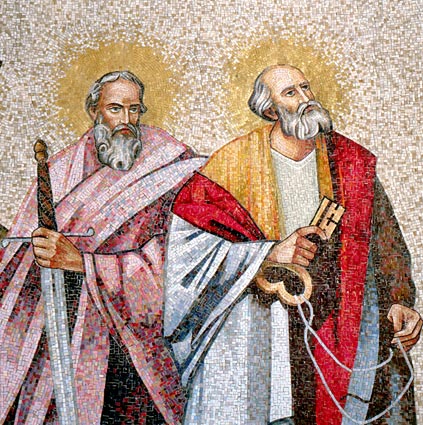
By celebrating Peter and Paul together, the Church presents two very different personalities: the fisherman from Galilee and the learned rabbi from Tarsus; the man of spontaneous action and the man of profound reflection. Yet both are united by the same experience: they were encountered by the mercy of Christ and transformed into courageous witnesses of the Gospel. Their holiness did not consist in the absence of weakness, but in their willingness to allow God to work through their weaknesses.
This Solemnity invites us to reflect on two essential questions. First: Who is Jesus Christ for me? Not merely a response learned by heart, but an answer born of a personal encounter with Him. Second: Do I trust in the Lord even when I find myself in situations of trial, uncertainty, or apparent captivity? Peter and Paul bear witness that the Lord never abandons those who place their trust in Him. He delivers when the time for deliverance has come, He strengthens when perseverance is required, and He always leads His people toward the fullness of His Kingdom.
As Saint Paul confidently proclaims: “The Lord will rescue me from every evil attack and will bring me safely to His heavenly Kingdom” (2 Timothy 4:18). Peter and Paul lived in the certainty of this promise; we too are called to walk forward in the same faith and hope.