“Lord, You are truly the Savior of the world; give me living water, so that I may never thirst again”
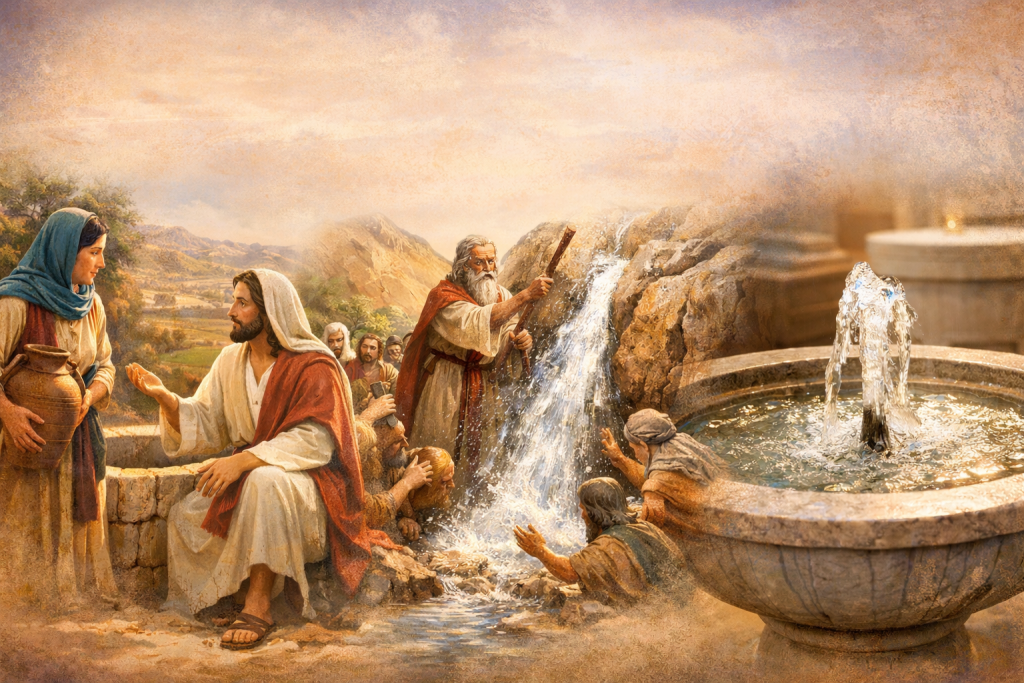
This Sunday begins the great Johannine Gospel readings. In the Gospel of John (4:5–42), we encounter the story of Jesus and the woman of Samaria—a profoundly symbolic meeting.
The Samaritan woman is a figure of complex meaning. She is a woman who reveals herself to have an immoral personal history. Yet she also represents religiously mistaken humanity. She is religious, but marked by flaws, sins, and betrayals.
The theme of husbands is significant: she has had five, and the one she now has is not her husband. This detail symbolizes a betrayed covenant. The true husband should be the Lord, the Spouse of the Covenant. Samaria, however, had become a heretical people—a nation mixed with other peoples and other religions. The Samaritan woman therefore represents a vaguely religious humanity with its own ideas. Many people say, “I believe… but in my own way.” She represents someone who holds personal religious ideas but, upon meeting Jesus, discovers that He is the Truth.
After her encounter with Christ, she leaves her jar by the well and no longer draws that water. Instead, she changes. She goes to announce that she has found someone who has revealed her life to her—someone who has read her life and interpreted her sin. Yet He does not mistreat or humiliate her. Rather, He helps her understand her mistakes and offers her hope. He promises her living water that springs up to eternal life.
At first, the woman thinks only of physical water. Instead, Jesus uses this image to speak of the Holy Spirit. God’s gift is the Holy Spirit.
At the center of the narrative, the woman asks Jesus an important question:
“Where must we worship God? On this mountain or in Jerusalem? In Samaria or in Jerusalem?”
Jesus responds: “Neither on this mountain nor in Jerusalem will you worship the Father. The Father is seeking true worshipers, and those who worship Him must worship in Spirit and in Truth.”
When Jesus speaks of the Spirit, He does not mean an abstraction. He means the Holy Spirit—the power of God given to us. In Johannine language, “Truth” refers to revelation. Jesus Himself is the Truth. He came to make God known and to reveal the face of the Father. Therefore, “Spirit and Truth” expresses a profoundly Trinitarian reality: the Holy Spirit given by Jesus, who is the Revelation of the Father. We must worship the Father in the Holy Spirit given through Jesus Christ.
The gift of the Spirit is symbolized by water, and the baptismal theme is clear. In this case, it is not water in which one immerses oneself, but water to drink—an image of the Spirit. We were baptized not only with water but with the Holy Spirit. We were immersed in the Spirit given by Jesus, and thus we became true worshipers of the Father. We leave our former life behind and begin a new life animated by the Spirit.
The theme of water is taken up again in the first reading. As always during Lent, it presents an important stage in salvation history. We have already encountered Adam and then Abraham. This Sunday we are introduced to Moses in the scene of water flowing from the rock.
The people complain despite the benefits they have received from God. They are thirsty and find no water in the desert. Moses, faithful to God’s instruction, strikes the hard rock with his staff, and a spring gushes forth. Water flows from the rock.
This is a powerful image that recalls the gift of the Spirit. If the rock is Christ, then from the rock flows the Spirit. Christ, our foundation and our rock, gives living water through the Spirit.
The Apostle Paul reiterates this idea in the second reading. In the opening verses of chapter 5 of the Letter to the Romans, he explains that we are justified by faith. Having been immersed in Christ through the waters of baptism, we have become righteous. It is on the basis of Christ’s faithfulness that we are saved, and through our adherence to Him we are at peace with God. Through Him, by faith, we have access to the Father. We can freely enter, as children, into communion with the Father.
Yet we are still on a journey. We have been saved in hope, and we strive toward fullness. This hope does not disappoint, because the Holy Spirit has been poured into our hearts.
Therefore, the dominant theme of all these readings is the gift of the Holy Spirit. The image of water leads us back to the source of life. It is the Spirit of God, given to us, who from within calls us: “Come to the Father.” Jesus and the Spirit give us the ability to approach God, to worship Him, and to listen to His voice.
This is the great lesson of the entire Lenten season, as Psalm 94 reminds us: listen to the Lord, do not harden your hearts, and allow yourselves to be guided by the Spirit who has been given to each of us.