Nineteenth Sunday in Ordinary Time (Year A) 2026 – ““Take courage, it is I; do not be afraid.”
The readings for this Sunday lead us into one of the deepest experiences of faith: seeking and recognising God’s presence precisely when our lives pass through silence, trial, and storm.
In the first reading, we encounter the prophet Elijah on the mountain. He is a weary and tested man who has experienced the demands of his mission and the burden of solitude. He stands before God, waiting to encounter Him. A powerful wind passes by, followed by an earthquake and a fire, yet the Lord is not revealed in any of these dramatic events. After the fire comes “the sound of a gentle breeze,” and Elijah recognises the presence of God. This image speaks deeply to our own lives.
We are often accustomed to looking for God in extraordinary experiences, great signs, and immediate answers. We would like the Lord to reveal Himself clearly, to resolve our difficulties quickly, and to remove every uncertainty from our path. Scripture, however, reminds us that God often reveals Himself in silence, in quietness, and in simplicity. If we are to hear the voice of God, we must learn to become still and listen.
We live in a world constantly filled with words, images, information, and noise. Even within us, there can be a great deal of turmoil: worries, questions, fears, and thoughts that do not allow us to rest. In such an environment, the voice of God may seem faint. Not because God has stopped speaking, but because we need to pause and learn once again how to listen.
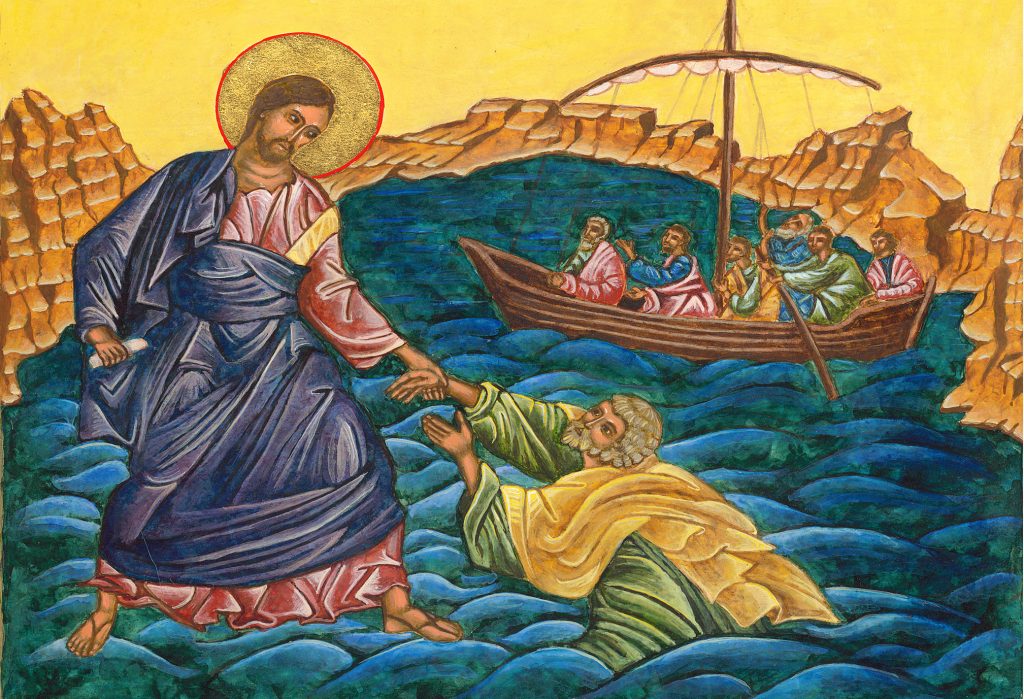
The Gospel takes us to the Sea of Galilee. The disciples are in the boat while Jesus is elsewhere. The wind is against them, and the waves are battering the boat. It is night, and fear begins to take hold of them. It is precisely in this situation that Jesus approaches His disciples, walking on the sea. They are frightened and think they are seeing a ghost. But Jesus speaks words that are simple and decisive: “Take courage, it is I; do not be afraid.”
These words have echoed throughout the centuries, and they reach us today.
Jesus does not promise His disciples that the wind will never blow again. He does not tell them that their lives will henceforth be free from difficulties. He simply says: “It is I.”
This is the fundamental certainty of faith: God does not promise us a life without storms; He promises us His presence in the midst of the storms of our lives.
Keeping our eyes fixed on Christ Peter also helps us to understand this truth. He asks Jesus to allow him to come to Him across the water. When Jesus invites him, Peter steps out of the boat and begins to walk. For a moment, he appears capable of doing what, humanly speaking, seems impossible. Then Peter takes his eyes off Jesus.
He looks at the wind, sees the power of the waves, and becomes afraid. It is then that he begins to sink. How often do we experience the same thing? When our gaze remains fixed on the Lord, we find the strength to face what seems impossible. When we allow our difficulties to occupy our entire attention, fear begins to take over.
The circumstances may not have changed. What has changed is where we are looking.
Peter begins to sink, but he does not give in to despair. He still has the strength to turn towards Jesus and cry out: It is one of the simplest and, at the same time, one of the deepest prayers we can ever make. We do not always need many words before God. There are moments when it is enough to say: “Lord, help me.” “Lord, sustain me.” “Lord, do not leave me alone.” “Lord, save me.”
And the Gospel tells us that Jesus immediately stretches out His hand. This is a profoundly consoling image. Peter is not abandoned in his weakness. His faith is uncertain and his fear is real, but the hand of Christ is stronger than his weakness. God is present in our storms We too may experience moments when we feel that we are sinking: a family difficulty, suffering, disappointment, anxiety about the future, or a personal or spiritual crisis. At such times, we may feel that God is far away. The Gospel invites us to look at reality with different eyes. Christ may be closest to us precisely when we feel most distant from Him. The second reading presents Saint Paul, who expresses profound sorrow for his people. His words show us that faith does not make the heart indifferent to the suffering of others. On the contrary, an encounter with God makes the heart more capable of loving, of sharing in the suffering of others, and of bringing their pain before the Lord. This raises an important question for our own Christian lives: Does our faith make us more attentive to others? An authentic faith cannot turn us inward upon ourselves. If we have encountered Christ, we cannot remain indifferent to those who suffer. The pain of another person, someone’s loneliness, the difficulties of a family, and the fragility of those we meet along the way become realities that we can bring into our prayer and, whenever possible, into our service.
The three readings of this Sunday can therefore be gathered around three fundamental attitudes.
Elijah teaches us to listen to God in silence. Paul teaches us to have a heart capable of loving and suffering with others. Peter teaches us to trust in Christ even when the wind is against us.
The Word of God invites us, therefore, not to measure the presence of the Lord solely by our emotions or by the absence of difficulties. God is not present only when everything is going well.
He is present in the night. He is present when the boat is shaken by the waves.
He is present when we cannot find an answer. He is present when our faith becomes fragile.
And it is precisely then that His word continues to resound:
“Take courage, it is I; do not be afraid.”
Faith does not mean becoming people who never experience fear. Faith means learning not to allow fear to have the final word. Peter is afraid, but he cries out to Jesus. Elijah is tired, but he continues to seek the Lord. Paul suffers, but he does not cease to love.
We too may be afraid. We may feel exhausted. We may pass through moments of doubt and suffering. What matters is that we do not stop seeking the Lord and turning to Him.
Perhaps this is precisely what Jesus asks of us today: not to be afraid of our weakness, but to entrust it to Him. When we feel that we are sinking, we should not be ashamed to ask for help.
When the wind is against us, we should not think that we are alone.
When God seems silent, we must learn to listen even to the whisper of His presence.
For the Lord is not far from our lives. He is on our path. He is in our night. He is beside our boat. And when fear causes us to sink, His hand is already stretched out towards us. We can therefore conclude this meditation with the same prayer of Peter: “Lord, save me!” And, in the depths of our hearts, we can hear Christ’s response: “Take courage, it is I; do not be afraid.”